

When we speak about Nepal – China relations, we often think of diplomacy, trade, infrastructure, tourism and connectivity. We remember the journeys of Chinese pilgrims to Nepal, the artistic legacy of Araniko in China, the Buddhist heritage of Lumbini, and the long history of interaction across the Himalayas. We forgotten bridge between China and Nepal, there is another bridge between our countries that is quieter, more intimate and perhaps more enduring literature.
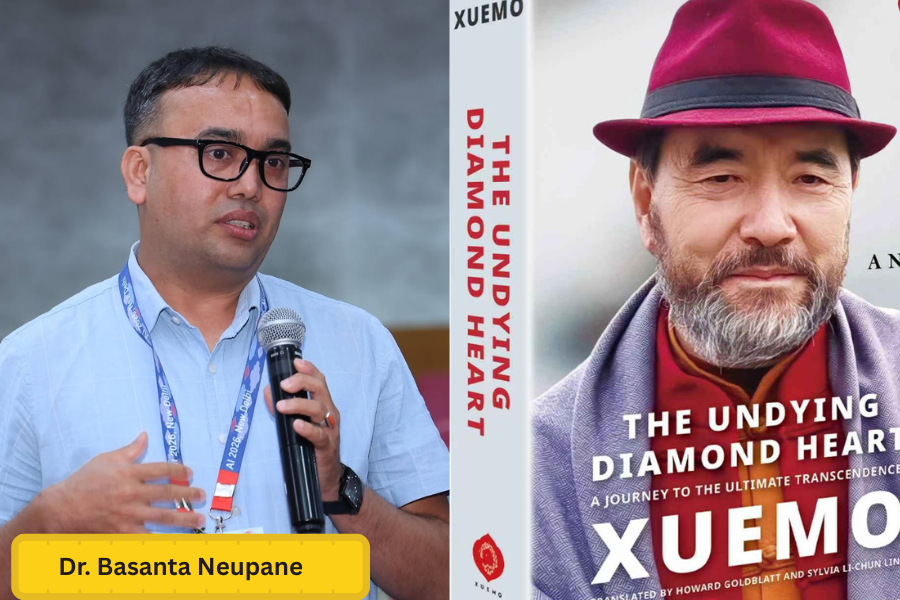
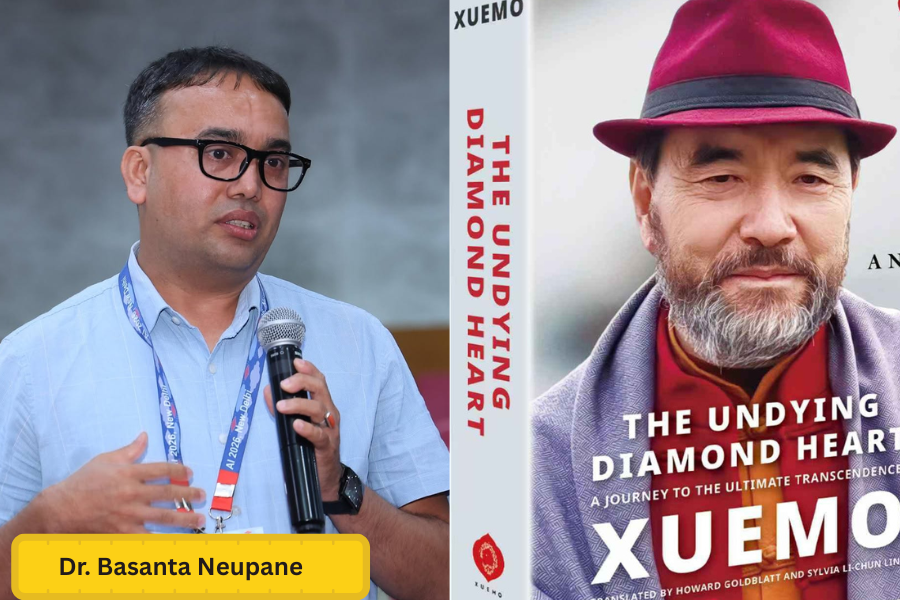
This is where the Chinese writer Xue Mo offers us something worth reflecting upon. His novel The Undying Diamond Heart, inspired by the life and spiritual journey of the Tibetan monk Khyungpo Naljor, takes readers across Tibet, and Nepal in search of knowledge, spiritual truth and self-realisation. The novel is a work of fiction and magical realism, but it draws on a historical and cultural landscape that connects the Himalayan societies of China, Nepal and India. Xue Mo himself describes the novel as an attempt to explore a relatively neglected chapter of Himalayan cultural interaction.
The Himalayas were a cultural bridge
For Nepali readers, this makes the novel particularly interesting, not simply because it is written by a Chinese author, but because Nepal becomes an important part of the story. When the Himalayas were a cultural bridge. Today, the Himalayas are often imagined as borders separating countries. Historically, however, they were also corridors through which monks, scholars, artists, traders and ideas travelled. Long before modern passports and political boundaries, people crossed the mountains in search of knowledge and spiritual wisdom.
Nepal’s own history reflects this extraordinary connectivity. The Nepali monk and scholar Buddhabhadra travelled to China in the fifth century. In the seventh century, Princess Bhrikuti became connected with the Tibetan royal court. In the thirteenth century, the Nepali artist Araniko travelled to China and left an extraordinary artistic legacy there. Chinese monks and scholars, including Faxian and Xuanzang, also travelled through the Himalayan region.
Nepal’s Ministry of Foreign Affairs itself describes these historical exchanges as part of the deep-rooted relationship between Nepal and China. These stories remind us of something important: the relationship between Nepal and China did not begin with the establishment of diplomatic relations in 1955. Diplomatic relations are modern. The cultural relationship is much older between us.
Xue Mo’s Himalayan Story
This is what makes Xue Mo’s literary work significant. Khyungpo Naljor is presented in the novel as a spiritual seeker who travels across the Himalayas in pursuit of Buddhist teachings and enlightenment. His journey takes him from Tibet into Nepal and India, where he encounters teachers, traditions and experiences that transform his understanding of himself and the world.
Kathmandu becomes an important setting in this journey. Here, the story introduces Saraswati, a former Kumari, and develops a relationship between her and Khyungpo Naljor. Their encounter brings together spirituality, human emotion, cultural traditions and the difficult choices faced by individuals searching for meaning. The novel should not be read as a conventional historical biography. Rather, Xue Mo uses historical inspiration, imagination and magical realism to explore a much larger question: What happens when people cross geographical, cultural and spiritual boundaries in search of truth? That question remains remarkably relevant today.
Nepal and China celebrated the 70th anniversary of diplomatic relations in 2025. The anniversary was not merely a celebration of seven decades of formal diplomacy; it was also an opportunity to remember the much longer history of friendship, cultural interaction and mutual learning between the peoples of the two countries.
The two governments have repeatedly emphasized people-to-people relations, education, culture, tourism, youth exchanges and literary and cultural cooperation. Nepal’s Ministry of Foreign Affairs identifies cultural diplomacy as an important means of strengthening mutual understanding and projecting Nepal’s soft power. This is where literature can make a unique contribution. Governments can sign agreements. Leaders can hold meetings. Roads and airports can connect countries physically. But books connect people’s imaginations.
A Chinese reader who encounters Nepal through a novel may see the country not merely as a neighbouring state on a map, but as a place of ancient temples, living traditions, spiritual inquiry and human stories. Likewise, a Nepali reader encountering the Himalayan world through a Chinese writer may discover that the histories of Tibet and western China are not distant stories belonging only to another country. They are part of a wider Himalayan cultural landscape in which Nepal has also played a role.
Beyond Borders and Geopolitics
In today’s world, international relationships are often discussed through the language of geopolitics. Nepal and China certainly have important economic and strategic interests. Connectivity, trade, investment, tourism, technology, infrastructure and development cooperation all matter.
But relationships between societies cannot be sustained by economics and politics alone. They also require trust, cultural understanding and human familiarity. This is why cultural diplomacy matters. A novel cannot solve a border problem or build a highway. It cannot replace government-to-government cooperation. But it can do something that official documents cannot easily accomplish: it can allow one society to imagine the life of another. That is perhaps the greatest strength of Xue Mo’s work. His approach does not portray the Himalayas simply as a geographical obstacle. It presents them as a space of movement, encounter and transformation.
The mountains that appear to divide us geographically have, for centuries, also connected us culturally. For Nepali readers, there is another reason to take interest in The Undying Diamond Heart. Nepal is not merely an exotic background in the story. Kathmandu and its cultural and spiritual traditions become part of the protagonist’s transformation. That gives Nepali readers an opportunity to see familiar cultural heritage through an outside literary perspective.
Sometimes we understand our own history differently when someone from another culture tells a story about it. Xue Mo’s interest in the Himalayan world therefore creates an opportunity for dialogue between Chinese and Nepali writers, researchers, translators, universities and readers.
We should encourage more such exchanges, not only translations of Chinese books into Nepali, but also Nepali literature into Chinese. Nepal has countless stories waiting to travel across the Himalayas. The stories of Lumbini, Mustang, Kathmandu Valley, Araniko, Bhrikuti, Buddhist scholars, Himalayan communities, traditional knowledge and contemporary Nepali society can all become part of a broader literary conversation between the two countries.
The next chapter of Nepal – China relations should not be written only in government offices. It should also be written in universities, libraries, classrooms, literary festivals, museums and cultural centres. It should be written by young researchers who study each other’s societies, by translators who make literature accessible, by filmmakers who tell shared stories, and by writers who dare to cross cultural boundaries.
There is already a foundation for this. Nepal and China have promoted cultural festivals, educational exchanges, language programmes, tourism, youth exchanges and people-to-people contacts. Chinese language education has also expanded through institutions such as the Confucius Institutes at Tribhuvan and Kathmandu University.
We should establish more literary translation programmes. We should encourage joint research on Himalayan geography, history and civilisation. We should invite researcher and writers from both countries to joint program. Universities should create platforms where young scholars can study the shared intellectual, geographical and cultural history of the Himalayas. And most importantly, we should allow ordinary people to encounter one another through stories.
A bridge built with stories
Perhaps this is the most important message of The Undying Diamond Heart. The story of Khyungpo Naljor is ultimately a story about a person crossing boundaries in search of wisdom. Xue Mo’s decision to bring this journey into contemporary literature creates another kind of crossing between history and imagination, between China and Nepal, and between Chinese and Nepali readers.
It reminds us that the Himalayas have never been only mountains. They have been a meeting place. They have carried monks and merchants, artists and scholars, ideas and philosophies. They have witnessed encounters between cultures that were separated by geography but connected by curiosity and human aspiration. Today, Nepal and China have a strong foundation of diplomatic friendship, and both countries continue to emphasize people-to-people and cultural exchanges.
The challenge now is to give that friendship a deeper human dimension. Xue Mo’s literature offers one small but meaningful example of how this can happen. A book cannot build a bridge of concrete and steel. But it can build a bridge inside the human mind. And sometimes, those are the bridges that last the longest. Perhaps the story of Khyungpo Naljor therefore has something to tell us in the twenty-first century: our future does not require us to forget our borders, but it does require us to understand the histories, cultures and human experiences that existed before those borders. Khyungpo Naljor is a real‑life figure in human history. Therefore, this book fills a gap in the research on China‑India and China‑Nepal cultural exchanges, calling for further exploration and study by more experts and scholars.
बिज्ञापन


(Dr. Neupane is a Geographer, working at Nepal Health Research council as a spatial halth expert, for contact – [email protected]).
बिज्ञापन